

Small Is Big: Why SaaS for Small Retailers Can Be a Bigger Opportunity
In SaaS, there is a natural temptation to chase big customers.
Large companies have bigger budgets, larger teams and seemingly bigger problems. One enterprise customer can sometimes be worth hundreds or thousands of small customers.
But there is another way to look at the market.
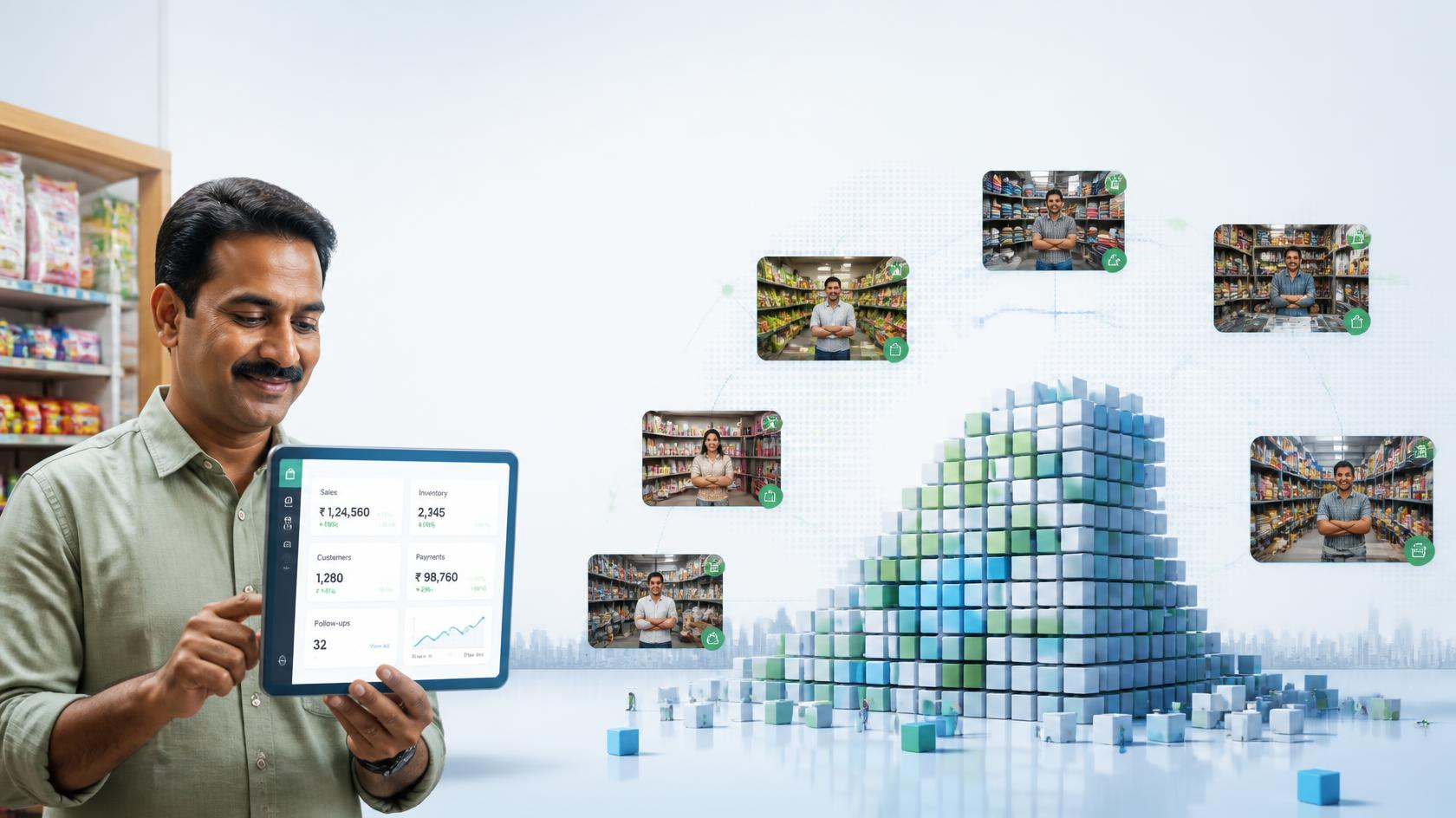
What if the real opportunity is not selling expensive software to a few big businesses, but building simple, useful software that thousands—or even millions—of small businesses can actually afford?
That is where small becomes big.
Every Penny Matters
For a small retailer, ₹1,000 is not just a software expense.
It is money that could pay for electricity, transportation, inventory, staff wages or a supplier payment.
That changes the way SaaS should be designed for this market.
A small retailer does not necessarily need a complicated ERP with hundreds of modules.
They may simply need to know:
- Which products are selling fastest?
- Who owes me money?
- Which customers have not purchased recently?
- What is my actual profit?
- Which salesperson is performing?
- What stock is running low?
- Which follow-ups are pending?
- What should I focus on today?
These are simple questions.
But answering them consistently can have a meaningful financial impact.
The technology does not have to be massive.
The value has to be meaningful.
The Mistake: Building Big Software for Small Businesses
One of the biggest mistakes in SaaS is assuming that small businesses need a smaller version of enterprise software.
They don’t.
They need different software.
Enterprise software often starts with:
“What features can we provide?”
Small-business SaaS should start with:
“What problem can we solve today that saves this business money or helps it make money?”
That difference is enormous.
A retailer may not care about 50 dashboard widgets.
But they will care deeply if your software helps them recover ₹20,000 in pending payments.
They may not need an advanced analytics engine.
But they may pay for a simple report showing which products are generating the most demand.
They may not need a sophisticated CRM.
But they absolutely need to know which customer was supposed to be called yesterday.
Small software solving a real problem can create bigger value than big software nobody uses.
The Economics of Small SaaS
There is another reason this market is interesting.
The number of small retailers is enormous.
You don’t necessarily need to convince one business to pay ₹2 lakh for software.
You can build a product that 10,000 businesses can comfortably pay ₹500–₹1,000 per month for.
At scale, the mathematics changes.
₹500 × 10,000 businesses = ₹50 lakh per month.
The opportunity comes from volume, affordability and retention, not from extracting maximum revenue from every individual customer.
This is the fundamental SaaS advantage:
Low price × large market × recurring revenue = a very large business.
Build for the Ability to Pay
The question should not simply be:
“What can we charge?”
It should be:
“What can a small retailer comfortably pay every month without thinking twice?”
That mindset can completely change product development.
Instead of building 100 features and charging ₹2,000, perhaps build the 10 features that matter most and charge ₹399.
Instead of selling software as a technology product, sell it as a business utility.
For example:
₹499/month to know where your money is.
₹699/month to manage sales and follow-ups.
₹999/month to connect customers, orders, inventory and payments.
The exact pricing will vary by product and market.
The principle remains the same:
Make the entry price small enough that adopting the software feels easier than continuing with the problem.
Small Retailers Don’t Need More Technology. They Need More Control.
This is perhaps the most important distinction.
Technology is not the product.
Control is the product.
A retailer wants control over:
Sales.
Stock.
Customers.
Payments.
Employees.
Follow-ups.
Profitability.
If software provides that control through a simple interface, it has value.
And if it can do that without requiring a dedicated IT person, expensive implementation or months of training, its value becomes even greater.
The Scale Is Hidden in the Market
There is a tendency to think:
“Why build software for a business that can only pay ₹500 a month?”
The better question is:
“How many businesses can pay ₹500 a month?”
This changes the entire SaaS equation.
A small retailer is not necessarily a small customer.
They are one unit of a very large market.
If the product is easy to understand, easy to implement, affordable and genuinely useful, distribution becomes the growth engine.
And once thousands of businesses use the same platform, additional services become possible:
- Payments
- Business financing
- Inventory intelligence
- Customer engagement
- Marketing automation
- Supplier management
- Business analytics
- AI-powered recommendations
- Marketplace integrations
The initial SaaS product can become the entry point into a much larger ecosystem.
The Future May Belong to “Micro-SaaS for the Masses”
The next generation of business software does not necessarily have to be built around large enterprises.
It can be built around millions of underserved businesses.
A retailer should be able to open an app and immediately understand:
“What happened in my business today?”
And perhaps even more importantly:
“What should I do next?”
That is where SaaS becomes truly useful.
Not when it gives businesses more screens.
Not when it gives them more reports.
But when it helps a business owner make better decisions with less effort.
Small Is Not Cheap. Small Is Focused.
There is an important difference between cheap software and affordable software.
Cheap software tries to reduce development cost.
Affordable software tries to maximize the value delivered for every rupee the customer spends.
That is the real opportunity.
Build something small.
Solve one painful problem.
Make it extremely easy to use.
Price it so the customer can afford it.
Make the value visible.
Then repeat the model across thousands of businesses.
Because when every penny matters, the software that saves a few hundred rupees—or earns a few thousand—can become far more valuable than software costing ten times more.
The Big SaaS Opportunity
The future of SaaS may not always be:
“How much can we charge one customer?”
It may increasingly be:
“How many businesses can we help, and how little can we charge while still creating meaningful value?”
Because there are millions of small businesses.
Millions of owners trying to control cash flow.
Millions trying to increase sales.
Millions trying to reduce wastage.
Millions trying to manage people.
Millions trying to compete with bigger businesses.
They don’t need technology built for giants.
They need technology built around their reality.
And that is why, in SaaS,
Small Can Be Very, Very Big.
At Krimanj Technology Services (KTS), we believe technology should not be a luxury reserved for large businesses. Since 2004, we have been helping businesses turn everyday operational challenges into practical, affordable and meaningful technology solutions.
Our focus is simple: build technology that businesses can actually use, afford and benefit from. From custom web and mobile applications to business management systems, B2B platforms, sales automation and SaaS solutions, we create technology around the way your business works—not the other way around.
If you are a small or growing business looking to use technology to improve sales, reduce manual work, gain better control or make smarter decisions, let’s talk.
Krimanj Technology Services
Technology that makes your business work smarter.Contact us to discuss your business requirement and explore a practical technology solution.